
Aeration of an aquarium is one of the most important aspects of husbandry to pay attention to. But what about the quality of the air our tanks “breathe” for aeration? It’s the same air we breathe, so we should know something about it. But how much do we all really know?
First some basic numbers for perspective.
How Big Is A Typical House?
A typical 2000 square foot house contains something like 15,000 cubic feet of space.
The average bedroom size in the US is supposedly around 1000 cubic feet.
Volume Of Air A Typical Person Breathes.
A person breathes about 300 cubic feet of air per day.
What Does It Take to Make Air Stale?
Bedroom air, for a common example, can start to feel stale after just 2-4 hours of sleeping if the door and windows to the room are closed. This is from buildup in the air of things like humidity and CO2.
So breathing at a typical rate in a typical bedroom while you sleep can make the air stale in just two to four hours.
This happens due to the way we use the air and seemingly in spite of the fact that you’re only using something like 36 (out of 1000) cubic feet of air in the room. That’s only around 3-4% of the air in the room, but enough to make it stale.
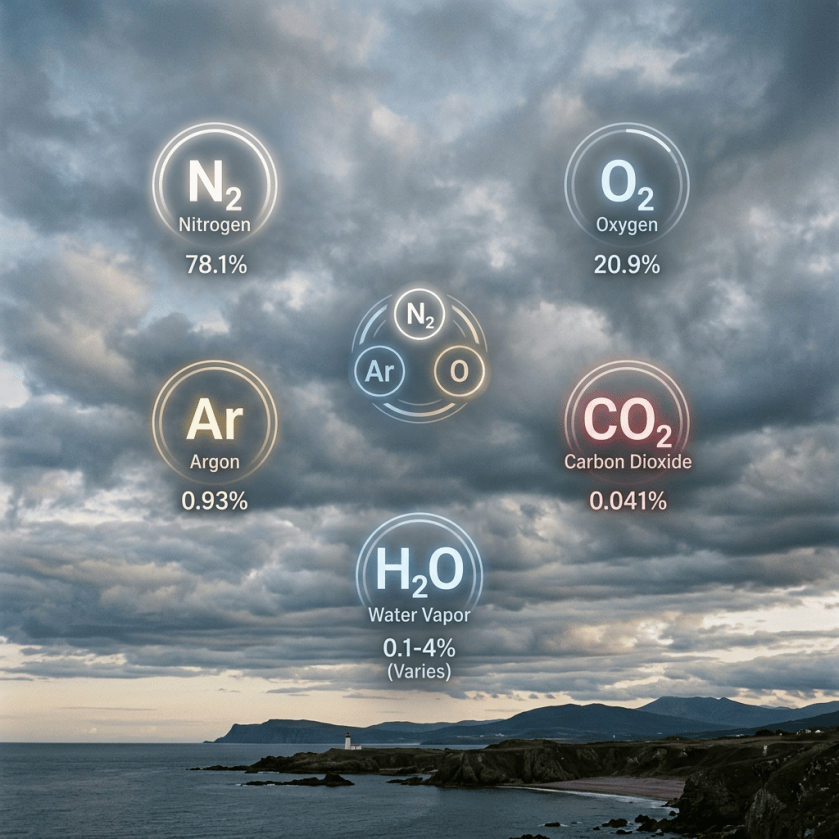
Part of the reason it’s so easy to “stale” the air this way is CO2, which is a very small part of fresh air, maybe 0.1%. It doesn’t take much added quantity to skew that low of a percentage.
Fresh air has around 400 ppm of CO2 in it. Some folks have measured CO2 levels in the bedroom as high as 4,000 ppm by the end of a night of sleeping. Measurements from 1,000-2,000 ppm don’t seem uncommon.
How Does This Apply To Aquariums?
A protein skimmer for a 50 gallon saltwater tank can consume over 300 cubic feet of air per day.
So a person breathes around the same amount of air per day as a 50 gallon saltwater tank.
Like the bedroom example above, does the reef tank in a closed room stale its air in as little as a few hours?
Total body mass and other factors are much different compared with a human, so CO2 produced is relatively small and insignificant, so staling the air so fast would not be likely under normal circumstances.
Most of the “added CO2” the tank is exposed to is from human household activities.
Does added CO2 matter? Probably not. But maybe.
Seawater naturally trends toward 8.1-8.2 with full exposure to fresh air. Even with normal “used” indoor air, pH doesn’t seem to trend lower than around 7.7 in almost all cases.
Probably not.
Stony corals don’t seem to have much problem across that range.
Sudies (like this1) indicate that under aquarium conditions, CO2 doesn’t have to be a problem even at elevated levels (tested at 800 ppm), as long as other nutrition factors scale up along with it (they added N, P and Fe; notably they did not try chasing pH).
But maybe (seems like there’s always a way to go wrong).
Lots of anecdotal aquarium evidence, both positive and negative, also supports that study’s findings. For example “low nutrient tank” fads come and go seemingly quite often with lots of stony corals RTN’ing along the way…probably because of how common elevated CO2 levels are in people’s fish rooms and homes. At the same time, aquariums housing fish have a natural tendency to accumulate dissolved nutrients and plenty of them have no issues growing stony corals at household/fish room CO2 levels.
So if you can verify that the air in the house is actually stale (as indicated by elevated CO2 levels), consideration toward making a permanent correction (maybe with or without professional help, depending on your situation) to your home’s HVAC (V=ventilation) is probably the most correct solution. Other responses to the situation that don’t bring fresh air in to displace stale air are less effective, and always very temporary if they are effective at all.
Nonetheless, some people feel they need to do something about the pH of their tank (but not the air that is anchoring it) when it doesn’t read 8.1 or 8.2 in a test. (Hint: Don’t chase pH numbers.)
One common reaction is to substitute sodium carbonate in place of baking soda for maintaining the tank’s alkalinity. Sodium carbonate is common baking soda that has been baked to remove the CO2. The common formula2 is to bake 2.25 cups of baking soda to prepare a batch of solution for dosing.
Ironically, doing that will generate enough CO2 to make a 50% increase (more than +200 ppm) in the concentration of the house air.
What To Do?
Most HVAC systems only move the air that’s already in a house – they do not bring in fresh air. If you engage in this practice of making carbonates from bicarbonates, it would be smart and efficient to run the kitchen exhaust fan during baking. It would also be interesting to have a CO2 monitor present to see how high CO2 actually gets AND to see how effective (or not) the exhaust is at removing CO2. The kitchen exhaust is far from perfect as you can tell when you cook anything smoky or smelly.
Houses do tend to get between .35 and 2 air exchanges per day…on the low side if it’s a new house, and on the high side if it’s a very poorly sealed house with lots of leaks. Notably, if your house is at the low end of that range it is on a borderline for not having enough fresh air – supplemental air exchange to the HVAC system is recommended by the EPA in several common instances in order to maintain healthy indoor air quality. Maybe running a reef tank should be one of those instances?
If you see “low” pH readings, rule out other causes and then use an inexpensive CO2 monitor to check your air quality.
1 “Long-term effects of nutrient and CO2 enrichment on the temperate coral Astrangia poculata” (2010)
2 “Aquarium Chemistry: A Homemade Two-Part Calcium And Alkalinity Additive System” (2004)

